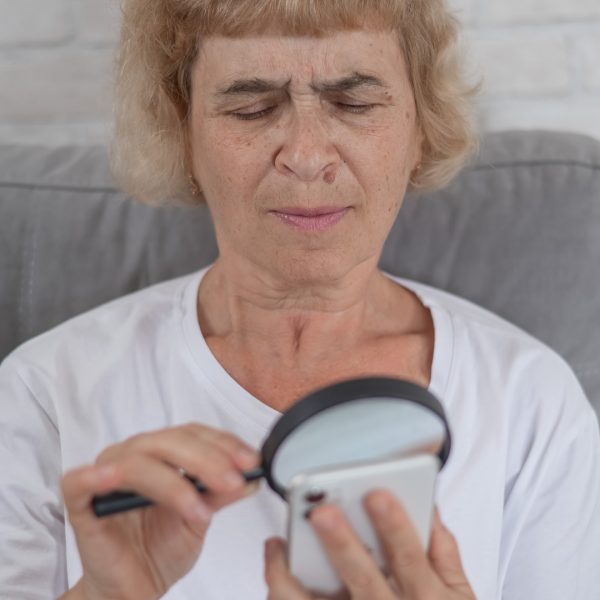
Age-related macular degeneration (or AMD) is a painless eye condition which affects the small central part of your retina at the back of your eye, called the macula.
The macula is responsible for your detailed central vision (the vision you use when looking straight at something), which is needed to recognize faces, drive and read. As such, AMD affects your central detailed vision, but not usually your peripheral (side) vision.
200 cases a day
Approximately 600,000 people in the UK1 currently have sight loss caused by AMD, and an estimated 71,000 new cases diagnosed every year2 (that’s nearly 200 cases a day). It is the most common cause of sight loss in the developed world and the third most common globally.
Causes of AMD
Unfortunately, the exact causes of AMD are not yet known, but there are a number of risk factors which may increase your risk of developing the condition:
- Age: AMD develops as people get older and is most often seen in those who are over 60, but it can develop from your 40s onwards.
- Gender: AMD is more common in women than men.
- Ethnicity: White people and people of Chinese ethnicity are more likely to get AMD than other ethnic groups.
- Lifestyle: A lack of exercise and high blood pressure may increase your risk of developing AMD.
- Smoking: The risk of developing AMD is greatly increased by smoking.
- Genetics: There are certain genes which seem to be linked to some people developing AMD, but not all AMD is thought to be genetic. If you have a family history of AMD, you may be at greater risk.
- Diet: A poor diet high in saturated fats (found in foods like processed meat, butter, and cheese) can increase your risk of AMD. A healthy balanced diet with plenty of leafy greens, vegetables, fruit, nuts, and fish can reduce your risk of developing AMD or slow the progression of the disease.
- Cardiovascular disease: Diseases that affect your heart and blood vessels may increase your risk of AMD.
- Sunlight: Some researchers believe that exposure to high levels of UV light in sunlight may increase your risk of developing AMD, but this has not yet been proven.
Symptoms of AMD
AMD often has no symptoms until the condition is advanced and your vision is affected. As such, it is very important you have regular eye tests so AMD can be caught early and your vision preserved.
Symptoms of AMD can vary, but below are listed some of the symptoms associated with this condition. Make an appointment with your optician if you notice any of these symptoms:
- Small blurred area in the middle of your vision.
- Problems with night driving.
- Unable to see fine details like small text.
- Distorted vision may make straight lines appear wavy or have bumps in them.
- Visual hallucinations (seeing things that aren’t there).
Diagnosis of AMD
The only way to detect macular degeneration is with an eye test. Make sure you schedule these regularly so that your eyes can be monitored for changes over time.
During the appointment, your eye specialist (optometrist or optician) will carry out a number of tests, like taking a picture of the back of your eye or conduct an OCT scan to get a better view of the structures inside the eye.
If your examiner thinks that you may have wet-AMD, they will refer you quickly to a specialist eye doctor (ophthalmologist) for treatment or for further testing.
Both wet and dry AMD are detected via the same exam. Sometimes more comprehensive eye tests will be used, such as a visual acuity test or Amsler grid test. They may even use special eye drops to dilate your pupils to allow your examiner to get a clear view of the back of your eye.
Treatments of AMD
Current treatments:
Although there is currently no cure for age-related macular degeneration, there are treatments available to help slow or mitigate the effects of AMD. The type of treatment depends on the stage and the type of late-stage AMD you have- dry AMD or wet AMD.
Treatments for wet AMD include:
- regular injections of medicine given directly into the eyes
- light treatment to destroy the blood vessels that cause wet AMD
With dry AMD, there are no treatments available at present. However, there is plenty of support on offer to help you manage it, including guidance on living with sight loss and support groups3.
Potential treatments:
At Sight Research UK, we are working tirelessly to find solutions to treat AMD. Your eye specialist can let you know if there are any clinical trials you could participate in or you can find an active clinical trial here. Here are just a few of our projects that we’ve been working on with researchers all over the UK:
Prevention of AMD
Have regular eye tests to detect issues early on
Before or during a diagnosis, you should have regular check-ups with a specialist to identify AMD and other eye issues before they can progress. It’s recommended that you have your eyes tested every 2 years. However, if you notice new or worsening symptoms between tests, you should contact your specialist as soon as possible.
Learn whether you are at higher risk of developing AMD
You may be at higher risk if you are:
- older
- have a family history of AMD
- smoke
- have high blood pressure
- White (particularly of Northern European descent).
Stay healthy
Age-related macular degeneration is often linked to lifestyle.
If you have it, try to:
- eat a balanced diet (read our Best foods for eye health A-Z for a list all the best provisions to maintain a healthy vision!)
- exercise often
- lose weight if you’re overweight
- stop smoking if you smoke
Did you know… a Western-style diet4 may be negatively impacting your eye health?
Different Types of AMD
There are two different types of Macular Degeneration: Dry AMD and Wet AMD.
Dry age-related macular degeneration
With Dry AMD, your macula gradually deteriorates as the cells which make it up die off and are not replaced over time.
Dry AMD is more common than wet AMD, and develops more slowly over time (sometimes it can take years for dry AMD to reach its final stage).
Having dry AMD does not mean you have dry eyes.
Wet age-related macular degeneration
Wet AMD (also known as Neovascular AMD) develops when your body grows new blood vessels to try and fix cells which have stopped working properly in the macula. These abnormal blood vessels can cause leakage of fluid and/or blood, which damages the macula and leads to vision loss.
Wet AMD accounts for 10-15% of people5 who develop AMD but is responsible for the majority of cases of severe vision loss. Many have had dry AMD before developing wet AMD. It can develop much faster than dry AMD, and you may notice significant changes in your central vision in the space of just a few days or weeks.
Meet Russell
Despite his AMD diagnosis, Russell has persevered and continues to enjoy his favourite hobbies made possible by sight-saving research treatments. Read his incredible story.

Without research, there are no treatments. And without funding, there is no research.
You can donate today to ensure that our research into AMD can continue, so that one day, we might have new treatments – or even a cure – for macular degeneration.
References and resources
- Age-related Macular Degeneration. The College of Optometrists.
- The estimated prevalence and incidence of late stage age related macular degeneration in the UK. PubMed National Library of Medicine. 2012.
- Local support groups. Macular Society.
- A High Fat “Western‐style” Diet Induces AMD‐Like Features in Wildtype Mice. PubMed National Library of Medicine. 2022.
- Current Trends and Challenges in Clinical Trials for Wet Age-Related Macular Degeneration: A Review. ResearchGate. 2025.